By Michael Nnebife
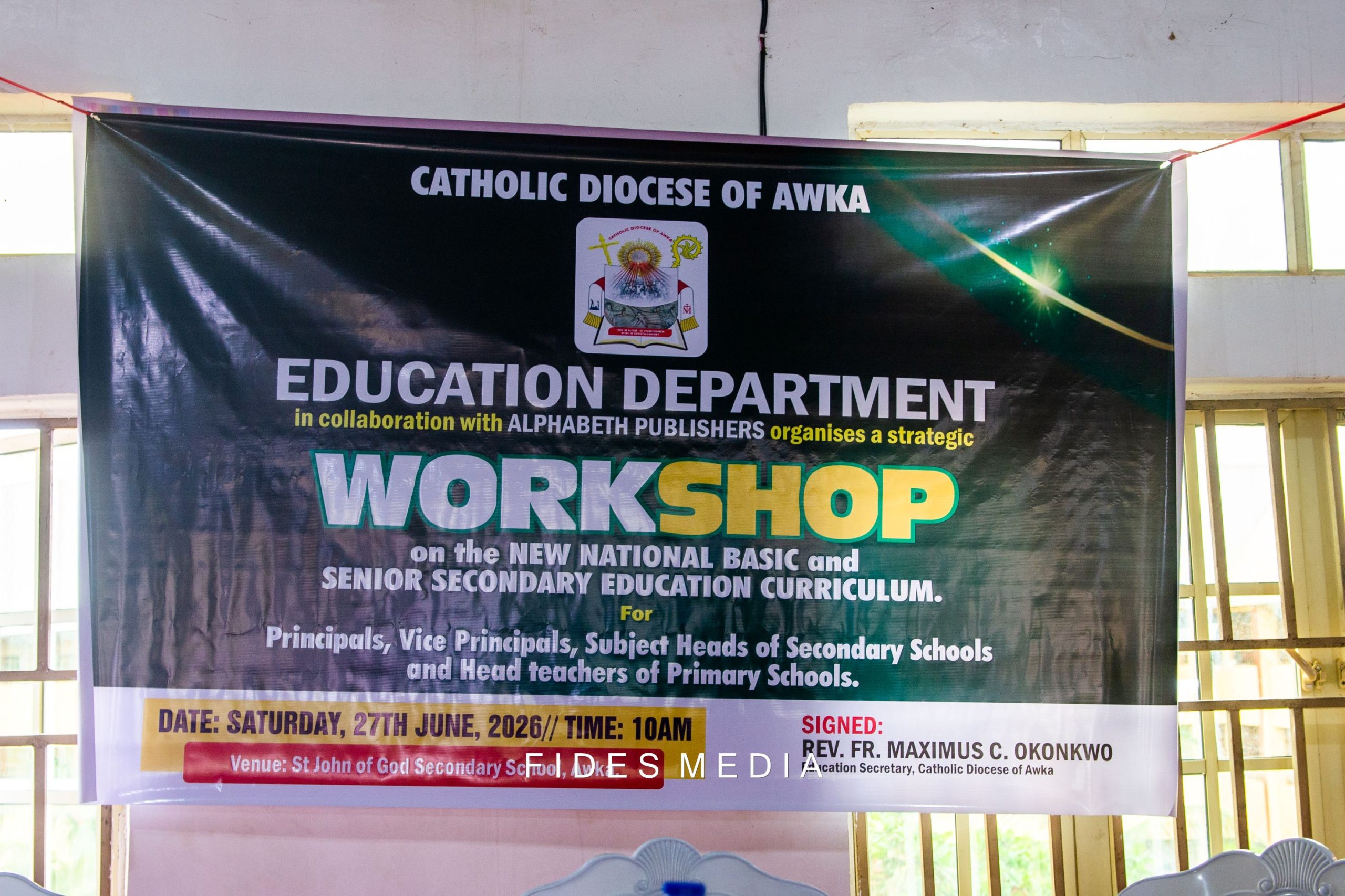
It was a moment of intellectual rearmament for primary and secondary schools of the Catholic Diocese of Awka, as the Education Department of the Diocese organized a strategic workshop on the implementation of the New National Basic and Senior Secondary Education Curriculum, aimed at equipping students with knowledge, skills, values and competencies required to thrive in the 21st century world.
Present at the one-day strategic workshop organized for Principals, Vice Principals, subject heads of secondary schools, and head teachers of primary schools, all of the Diocese, on Saturday, June 27, were the Bishop of the Diocese, Most Rev Paulinus Ezeokafor, represented by the Chancellor, Rev Fr Charles Ndubuisi; the Anambra State Commissioner for Education, Dr Ekene Ogugua, represented by the Principal Education Officer in the Anambra Education Ministry, Kenechi Ezeaku, among others.
 While declaring the capacity-building workshop, which took place at St John of God Secondary School, Awka, open, Bishop Ezeokafor said that Jesus Christ came into the world for people to not just have life, but also have it in abundance.
’When Jesus talked about abundance of life, he was talking about integral life, a life that touches not only intellectual formation, but also moral formation.
’Sometimes I hear the politicians say the Church is building more schools. Yes, it is so, because formation of the young people is at the heart of the Church.
’For us in the Diocese of Awka, this carries us with our own mission and vision.
’So, we pray and hope that the new curriculum will provide an opportunity for schools and teachers to inculcate a formation that is not limited to academic, but prepares the young people for a real life,’ the Bishop said, among others.
Welcoming the dignitaries and the participants, the Education Secretary of the Diocese, Rev Fr Maximus Okonkwo, said the introduction of the curriculum represented a strategic response to the emerging realities confronting the Nigerian Nation.
’It seeks not only to improve academic outcomes but also to foster critical thinking, creativity, digital literacy, entrepreneurship, problem-solving abilities, character formation and life-long learning among students,’ the Education Secretary said.
He explained further that the curriculum aimed at producing graduates who would be not merely certificate holders, but also responsible citizens, capable of contributing meaningfully to national and global development.
Noting that as society continued to evolve through technological innovations, globalization and changing socioeconomic realities, Fr Okonkwo argued that the educational system must also adapt to equip learners with the knowledge, skills, values and competencies required to thrive in the 21st Century World.
Fr Okonkwo thanked the participants at the workshop for what he described as their commitment to providing quality, relevant and transformative education for learners in the schools of the Diocese.
He also expressed gratitude to the resource person and Managing Director, Alphabet Nigeria Publishers, Dr TNJ Umunnakwe, for facilitating the workshop free of charge.
In his remarks, the Anambra Commissioner for Education, who said that the new curriculum was in line with the education agenda of Governor Chukwuma Soludo’s administration, commended the Education Department of Awka Diocese and Alphabet Nigeria Publishers, for coming up with the workshop.
Also speaking, the Chairman of the occasion, Sir Ogo Ezeonu, expressed happiness with the new ideas embedded in the curriculum, describing them as dreams of education lovers in the country.
 ‘If we put in place what is in this the curriculum, we shall realize that which the Church has been praying for,’ Sir Ezeonu said.
He applauded the Education Department of Awka Diocese for organizing the workshop and urged the teachers to ensure that all the ideas in the curriculum were inculcated to the students.
In his presentation, the resource person intellectually engaged the critical education stakeholders of Awka Diocese on two topics, focusing on the overview of the curriculum, and the implications of its structure on the scheme of work and classroom delivery.
Dr Umunnakwe, who told them that the curriculum offered between nine and 10 subjects to primary one to three pupils; and 10 to 12 subjects to those in primary four to six, explained that English Studies, Mathematics, one Nigerian Language, Basic Science, Physical and Health Education, Christian Religious Studies or Islamic Studies, Nigerian History, Social and Citizenship Studies, Cultural and Creative Arts, and Arabic Language (optional) were to be taught from primary one to three.
‘At primary four to six, you have English Studies, Mathematics, one Nigerian Language, Basic Science and Technology, Physical and Health Education, Christian Religious Studies or Islamic Studies, Nigerian History, Social and Citizenship Studies, Basic Digital Literacy, Cultural and Creative Arts, Arabic Language (optional), Pre-vocational Studies, and French.
’At the junior secondary, you have English Studies, Mathematics, one Nigerian Language, Intermediate Science, Digital Technologies, Physical and Health Education, Christian Religious Studies or Islamic Studies, Nigerian History, Social and Citizenship Studies, Cultural and Creative Arts, Business Studies, French, Arabic Language (optional), with six trade subjects, which are Solar Photovoltaic Installation and Maintenance, Fashion Design and Garment-making, Livestock Farming, Beauty and Cosmetology, Computer Hardware and GSM Repair, and Horticulture and Crop Production.
’A school will choose only two of the six trade subjects, study and specialize in them.
’At the senior secondary, you have five compulsory subjects – English Language, General Mathematics, Citizenship and Heritage Studies, Digital Technologies, and one trade subject,’ Umunnakwe said, among others, emphasizing that the curriculum was outcome-based.
 In a vote of thanks, the Assistant Manager, St Mary’s High School, Ifitedunu, Rev Fr Evaristus Mmadudiri, and Sir Clement Ofoegbu, expressed gratitude to the organizers of the workshop, pledging that the participants would do their best to ensure that the objective of the curriculum would be realized.
The workshop, which was also graced by the Secondary School Supervisors of the Diocese, and the officials of the Anambra State Universal Basic Education Board, featured a question and answer session between the participants and the resource person.